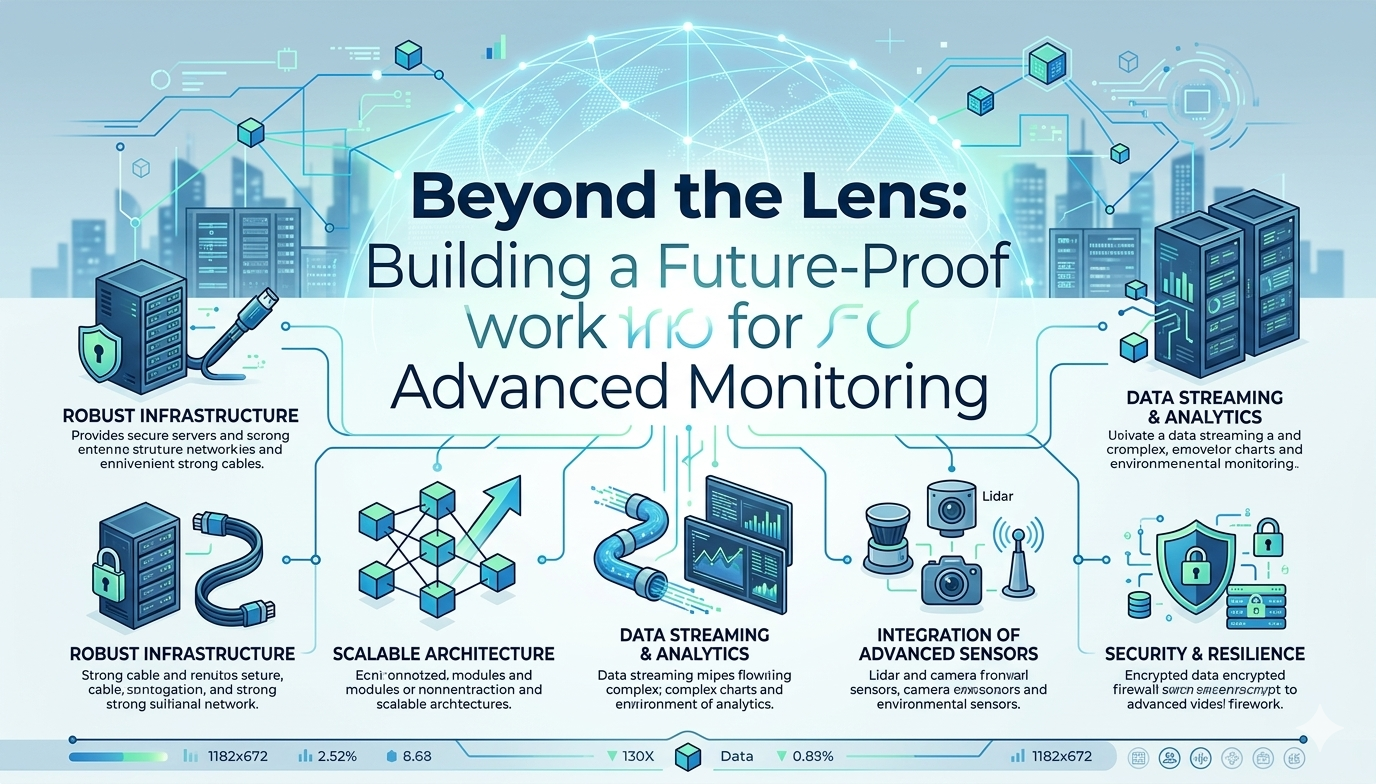
Beyond the Lens Building a Future-Proof Network for Advanced Monitoring
When we think about security, our minds often jump straight to the hardware we can see: the sleek domes of high-definition cameras perched on street corners or the glowing keypads at an office entrance. However, the true efficacy of these tools doesn’t lie in the glass of the lens or the plastic of the housing; it resides in the invisible web of data that connects them. As we transition into an era where artificial intelligence and cloud-based analytics define our safety protocols, the importance of the backend infrastructure has never been higher. Building a network that can handle the massive data demands of modern monitoring requires a shift in perspective, moving away from simple “plug-and-play” mentalities toward a philosophy of long-term structural integrity. This level of modern infrastructure requires meticulous planning, and utilizing a service like Network Cabling Inc. Escondido based ensures that the physical layer of the network is robust enough to handle high-definition data streams for years to come. By prioritizing this foundation, property owners can rest easy knowing their technology won’t be throttled by outdated wiring.
The Architecture of Awareness
The foundation of any high-performance monitoring system is the physical architecture that supports it, serving as the “nervous system” for the entire facility. In the past, security systems operated on closed loops with minimal data requirements, but today’s IP-based cameras and sensors demand a level of bandwidth that legacy systems simply cannot provide.
Designing for Scalability
A future-proof network must be designed with the understanding that technology will inevitably change. A system that works perfectly for ten cameras today might struggle when those cameras are upgraded to 4K resolution or when thermal sensors and facial recognition software are added to the mix. Designing for scalability means installing higher-grade cabling, such as Cat6a or fiber optics, than what is currently required. This proactive approach prevents the need for invasive and expensive “rip-and-replace” projects five years down the line, allowing the network to expand organically as the needs of the property evolve.
The Vital Link Between Speed and Safety
Bandwidth is the lifeblood of modern security, dictating how quickly an incident can be detected and how clearly it can be recorded. When a network is congested or poorly designed, video feeds may lag, frames may drop, and critical moments can be lost in a blur of pixels. This is particularly dangerous in high-stakes environments where every second counts. To ensure that high-resolution data reaches its destination without interference, the network must be optimized for low latency and high throughput. For those managing high-stakes environments, partnering with adr security in nyc can provide the necessary oversight to catch vulnerabilities in real-time before they manifest into actual losses. Maintaining this level of clarity is the only way to ensure that “advanced monitoring” is more than just a marketing buzzword.
The Power of Cloud-Based Intelligence
The shift toward cloud-based storage and remote management has revolutionized the way we interact with our security data. No longer are managers tethered to a specific monitor in a dark back room; they can now access live feeds and historical data from anywhere in the world.
Seamless Integration and Remote Access
Cloud integration offers a level of flexibility that was previously unimaginable, allowing for centralized management of multiple sites from a single dashboard. However, this convenience relies entirely on the strength of the internet connection and the internal network’s ability to upload large volumes of encrypted data to the cloud. By utilizing advanced video analytics, the system can distinguish between a falling branch and a human intruder, sending an instant alert to a smartphone. This intelligence reduces “alarm fatigue” and ensures that security personnel are only notified when a genuine threat is detected.
Building Resilience Through Redundant Systems
Reliability is the hallmark of a professional-grade security environment, and it is achieved through the intentional implementation of redundancy. If a single cable is cut or a single switch fails, the entire security net should not come crashing down.
Fail-Safes and Data Integrity
A resilient network utilizes redundant pathways to ensure that data always finds a route to its destination. This might involve “ring” topologies in the cabling or the use of uninterruptible power supplies (UPS) to keep cameras running during a blackout. Furthermore, “edge storage”, where cameras record to an internal SD card during a network outage and then sync back to the main server once connectivity is restored, provides an essential layer of protection against data loss. These layers of defense ensure that the system remains “always-on,” providing 24/7 protection regardless of external circumstances.
The Synergy of Hybrid Connectivity
While fiber optics is the gold standard for high-speed data transmission over long distances, a truly future-proof network often employs a hybrid approach. This involves a strategic blend of copper wiring, fiber, and even wireless “mesh” networks to reach difficult areas.
Balancing Performance and Cost
Fiber optics provides the high-speed backbone for the primary data center, while copper wiring handles the “last mile” to individual cameras using Power over Ethernet (PoE). PoE is a game-changer for security because it allows a single cable to provide both data and electricity, simplifying the installation process and reducing the number of potential failure points. Meanwhile, wireless bridges can be used to extend the network to remote gates or parking lots where trenching for cables would be cost-prohibitive. This hybrid strategy ensures that no corner of a property is left in the dark.
The Necessity of Expert Site Evaluations
Before a single cable is pulled or a single camera is mounted, a comprehensive site evaluation must take place to identify the unique challenges of the environment. Every building has its own “electronic fingerprint,” and factors like electromagnetic interference from heavy machinery or thick concrete walls can significantly impact network performance.
By conducting a thorough assessment, professionals can pinpoint the ideal locations for hardware and determine the most efficient routes for cabling. This phase of the project is where the most value is added, as it prevents common pitfalls like “signal ghosting” or bandwidth bottlenecks. Investing in an expert evaluation at the beginning of the process ensures that the finished system is not just a collection of parts, but a cohesive and reliable tool for safety and oversight. In the end, a future-proof network is an investment in peace of mind, ensuring that as the world becomes more digital, your security remains one step ahead.
About the Author