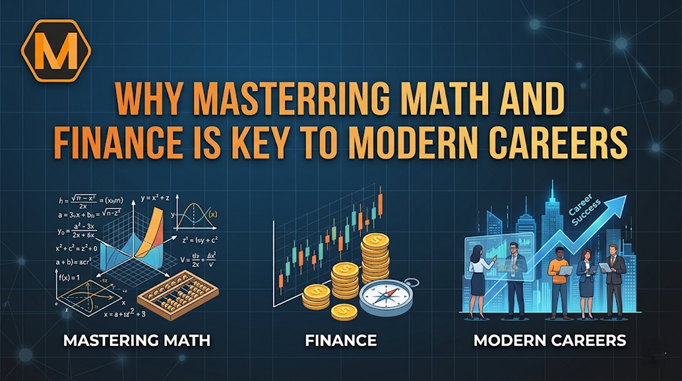
In an era defined by rapid technological shifts and data-driven decision-making, the landscape of professional success has fundamentally changed. It is no longer enough to be a specialist in a single niche; the modern workforce demands a multidisciplinary approach. At the heart of this evolution lies the intersection of mathematics and finance. These two disciplines, often viewed with trepidation by students, are actually the most powerful tools one can possess. Whether you are aiming for a seat in a boardroom, a role in tech innovation, or even a career in the creative industries, understanding the “language of numbers” provides a level of clarity and predictive power that few other skills can match.
The transition from general education to specialized professional life is frequently where students feel the most pressure. For those pursuing degrees in economics, business, or accounting, the workload can become intense, particularly when theoretical concepts meet real-world application. Navigating complex modules requires more than just showing up to lectures; it requires a deep dive into case studies and numerical analysis. During these high-pressure periods, many students find that seeking professional help with finance homework allows them to bridge the gap between classroom theory and the practical expertise required by global employers. By mastering these financial foundations early, students position themselves as high-value candidates in a competitive job market.
The Universal Language of Logic
Mathematics is often misunderstood as a series of abstract formulas designed to confuse. In reality, math is the ultimate framework for logic and problem-solving. When you study calculus, statistics, or linear algebra, you aren’t just learning how to solve for $x$; you are training your brain to identify patterns, evaluate risks, and construct logical arguments.
For undergraduate students, the ability to break down a complex problem into smaller, manageable parts is a skill that transfers directly to every career path. A software engineer uses logic to write clean code; a marketing strategist uses statistics to predict consumer behavior; and a doctor uses probability to determine the success of a treatment. Without a solid mathematical foundation, these professionals would be navigating their fields in the dark.
Bridging the Gap: Where Math Meets Finance
Finance is essentially mathematics applied to the real world. It is the study of how individuals, businesses, and governments manage their resources over time. When we look at the global economy, we see a massive web of mathematical relationships—interest rates, inflation, market volatility, and asset valuation.
To succeed in finance, one must be comfortable with the quantitative side of the equation. Understanding the time value of money, for instance, requires a firm grasp of exponential growth and discounting. Similarly, managing a corporate budget requires an intimate knowledge of ratios and percentages. For students currently tackling these subjects, the complexity can be daunting. If you find yourself struggling with the underlying calculations, it is often helpful to have an expert walk you through the steps. At Myassignmenthelp, students frequently discover that having a professional do my math homework provides the clarity needed to master more advanced financial modeling later in their degree. This support doesn’t just check a box for a grade; it builds the confidence necessary to handle quantitative data in a professional setting.
Comparison: Skills vs. Career Applications
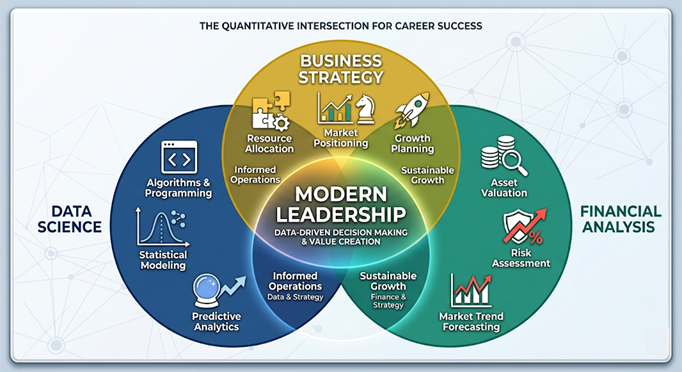
| Quantitative Skill | Financial Application | Career Relevance |
| Probability & Statistics | Risk Assessment & Insurance | Data Science, Actuarial Work, Marketing |
| Calculus | Optimization of Portfolios | Engineering, Quantitative Trading, Tech |
| Algebra | Interest Rates & Loan Amortization | Banking, Real Estate, Personal Finance |
| Data Analysis | Market Trend Forecasting | Business Intelligence, Management, Consulting |
Why Employers Value Quantitative Literacy
In a globalized economy, employers are looking for “evidence-based” decision-makers. They want team members who can look at a spreadsheet and see a story rather than just a wall of numbers. A professional who understands finance can tell a company where it is losing money and where it should invest for the future.
Furthermore, quantitative literacy acts as a shield against misinformation. In an age of “big data,” it is easy to be misled by skewed statistics or biased financial reports. Those who have mastered math and finance can verify information for themselves, making them more independent and reliable leaders. This is why top-tier firms in London, New York, and Sydney prioritize candidates who can demonstrate a high level of numerical competency regardless of their specific job title.
Overcoming the “Math Anxiety” Barrier
Many students avoid finance-heavy roles because of a long-standing fear of mathematics. This “math anxiety” often stems from a lack of support during the foundational years of university. It is important to remember that these skills are not innate; they are practiced.
The most successful students are those who recognize when they need a different perspective on a problem. Using resources like peer tutoring, office hours, or specialized academic services can turn a “weakness” into a “strength.” Once the fear of numbers is removed, the world of finance becomes an exciting playground of opportunity rather than a source of stress.
The Future of Work: AI and the Human Touch
While artificial intelligence is changing how we process data, it is not replacing the need for financial and mathematical expertise. If anything, it is making these skills more important. AI can calculate numbers at lightning speed, but it cannot interpret the “why” behind the data. Humans are still needed to set the parameters, ask the right questions, and make ethical decisions based on financial outcomes. By mastering these fields, you aren’t just competing with machines; you are learning how to direct them.
Final Thoughts for the Modern Student
Your university years are the best time to build a diverse toolkit. Don’t shy away from the “hard” subjects. Embrace the challenge of a finance module or a statistics elective. These are the courses that will pay dividends—literally and figuratively—for the rest of your life. Whether you are balancing your first budget or pitching a multi-million dollar project, the ability to speak the language of math and finance will always be your greatest asset.
Frequently Asked Questions (FAQ)
1. Why is finance important for students who aren’t business majors?
Ans: Finance teaches you resource management. Even if you are an artist or a scientist, you will eventually need to manage grants, run a freelance business, or plan for your own retirement. Financial literacy is a life skill, not just a career skill.
2. Is it too late to improve my math skills in university?
Ans: Never. Mathematics is a cumulative subject. If you find yourself struggling, it is usually because there is a gap in your foundational knowledge. By revisiting the basics and seeking targeted help, you can master even the most advanced quantitative concepts.
3. How does quantitative literacy help in leadership roles?
Ans: Leaders must make decisions that affect the sustainability of an organization. Understanding the financial implications of those decisions allows a leader to lead with confidence and provide clear, data-backed reasoning to their teams and stakeholders.
4. What is the best way to stay updated on global financial trends?
Ans: In addition to your coursework, follow reputable financial news outlets, listen to economic podcasts, and use academic support platforms to dive deeper into specific topics that interest you. Constant curiosity is the key to staying relevant.
About The Author
Hi, I’m Lucy Wilson. With over a decade of experience in academic consultancy and a deep passion for student success, I’ve dedicated my career to helping undergraduates navigate the complexities of higher education.
About the Author